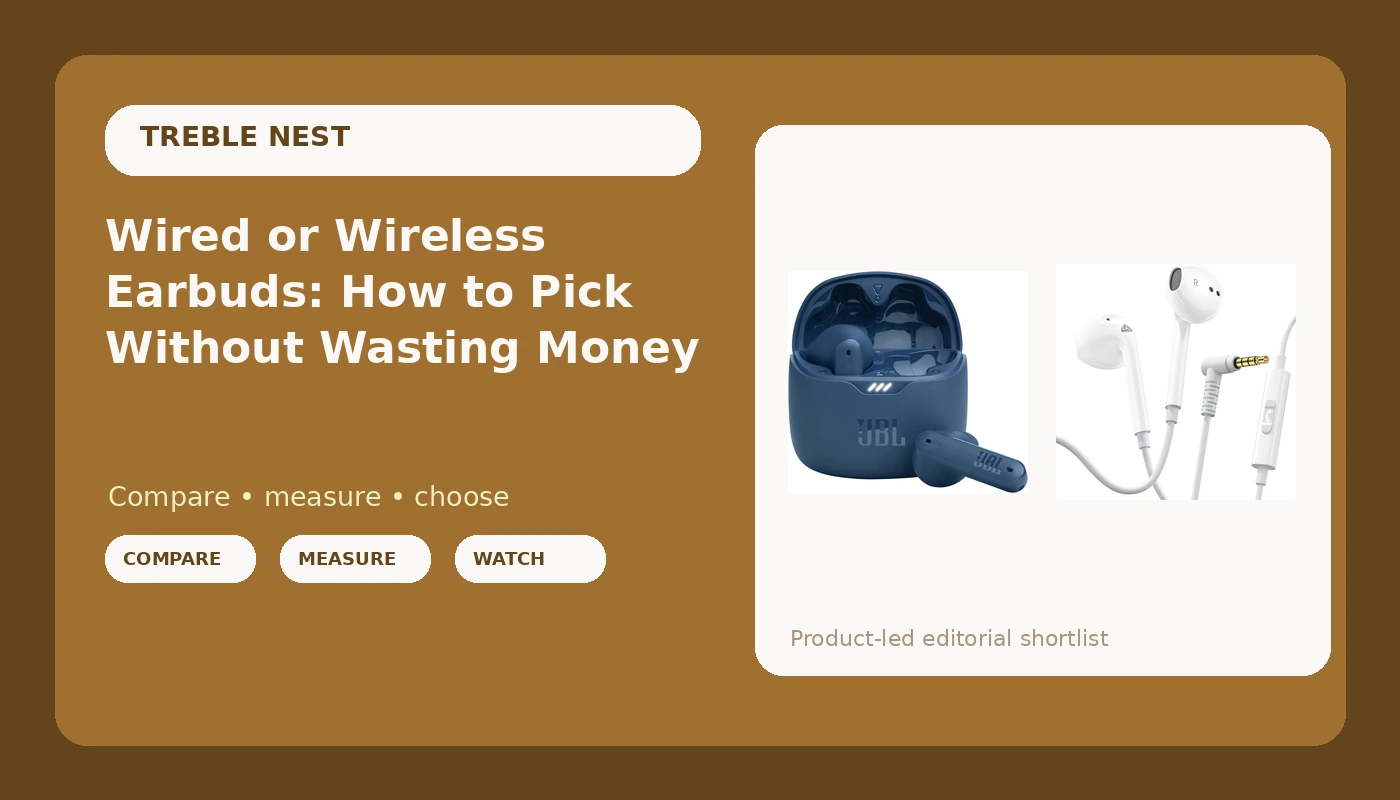
Wired vs wireless earbuds is not the argument people think it is. Nobody is asking whether copper sounds better than Bluetooth anymore, because most of us already know the answer and it does not change anything. The real question is whether you want a cable in your life or a battery in your life, and you have to pick one.
I held onto the 3.5mm jack for years. I own a drawer of dead adapters that proves it, each one lasting somewhere between six months and a year and a half before the connector went intermittent and the audio started cutting out when I moved my head. The phone moved on. So did I, reluctantly.
I do live sound and recording editing around Nashville. The pair I mix on stays home, on a stand, and costs more than my car insurance. The pairs I actually live with are cheap, and they get walked in, sweated in, dropped in parking lots, and used for phone calls on streets with a bus idling beside me. That is the tier this article is about: one wired option, one wireless option, and the five questions that decide which one you should actually buy.
Why you should trust me
I run monitor mixes in small venues and clean up podcast audio for a living, which means I spend my working hours listening for problems in sound rather than enjoying sound. My reference pair is a set of Sony over-ears that never leaves the house. Everything else in my life is budget gear, bought with my own money, and I have lost the same cheap pair twice and bought it a third time without hesitating.
Here is the part that matters for this article. My ear canals are small and they get sore easily. Every pair I have ever owned has hurt at some point, no matter the tip size or material, so when I say something is comfortable I mean it survived two weeks of my ears and not a reviewer's ears. I have also paid for every pair I have ever written about. No brand has sent me anything, and no one has paid for a placement on this page.
How I picked and how I tested
I do not trust the number on the box, and neither should you. The battery figure on a listing is measured at a volume nobody uses, in conditions nobody has. What I trust is the gauntlet I run on anything in this tier, which looks like this: battery drain at normal volume across a full week, each bud used solo with the other one sitting in the case, the volume floor checked at night when I want the quietest setting to actually be quiet, pairing stability on a walk through a neighborhood with a lot of interference, and a two week fit test on walks and workouts. It all goes in a spreadsheet.
For the two picks below, I am giving you the criteria that decide them and the honest limits of what I can promise you before you own them. A drain number for a pair I do not own yet would be a made up number, and this site does not do that. Treat any listing claim as a starting point and verify it inside the return window. That is the whole method, and it takes about a week.
What actually changes when you cut the cable
The honest answer first: buy wired if you want the lowest cost, zero charging, and no pairing, and you have a device with a 3.5mm port. Buy wireless if your phone has no port, or if you need noise cancelling, which wired pairs at this price basically never offer.
Everything else breaks down into six differences.
Battery. Wired has no battery to run out. That is not a small thing. A pair that dies after two hours is useless no matter how good it sounds, and battery life is the first spec I check on anything wireless.
Latency and dropouts. A cable cannot lag. Wireless can, and pocket dropouts on a walk are the most common complaint I hear about cheap wireless pairs. Good Bluetooth is stable, but you are trusting a radio instead of a wire.
Noise cancelling. This is the single biggest reason to go wireless, and it is the reason one of the picks below is in this article at all.
Independent use. Each wireless bud should work alone, so you can run one in an ear while the other charges. You do not realize you need this until you have it, and once you do, a pair that cannot do it feels broken.
The volume floor. Check the quietest setting before you commit. If the minimum volume is still loud enough to blast your eardrums, the pair is useless for night listening, and no spec sheet will tell you that.
The cable itself. It catches on door handles, tugs the bud out of your ear when it snags, and eventually fails at the strain relief. Wired pairs die at the plug far more often than at the driver.
The two earbuds I would start with
One for the jack, one for the jack-free life. Both sit in the budget tier where I actually spend my money.
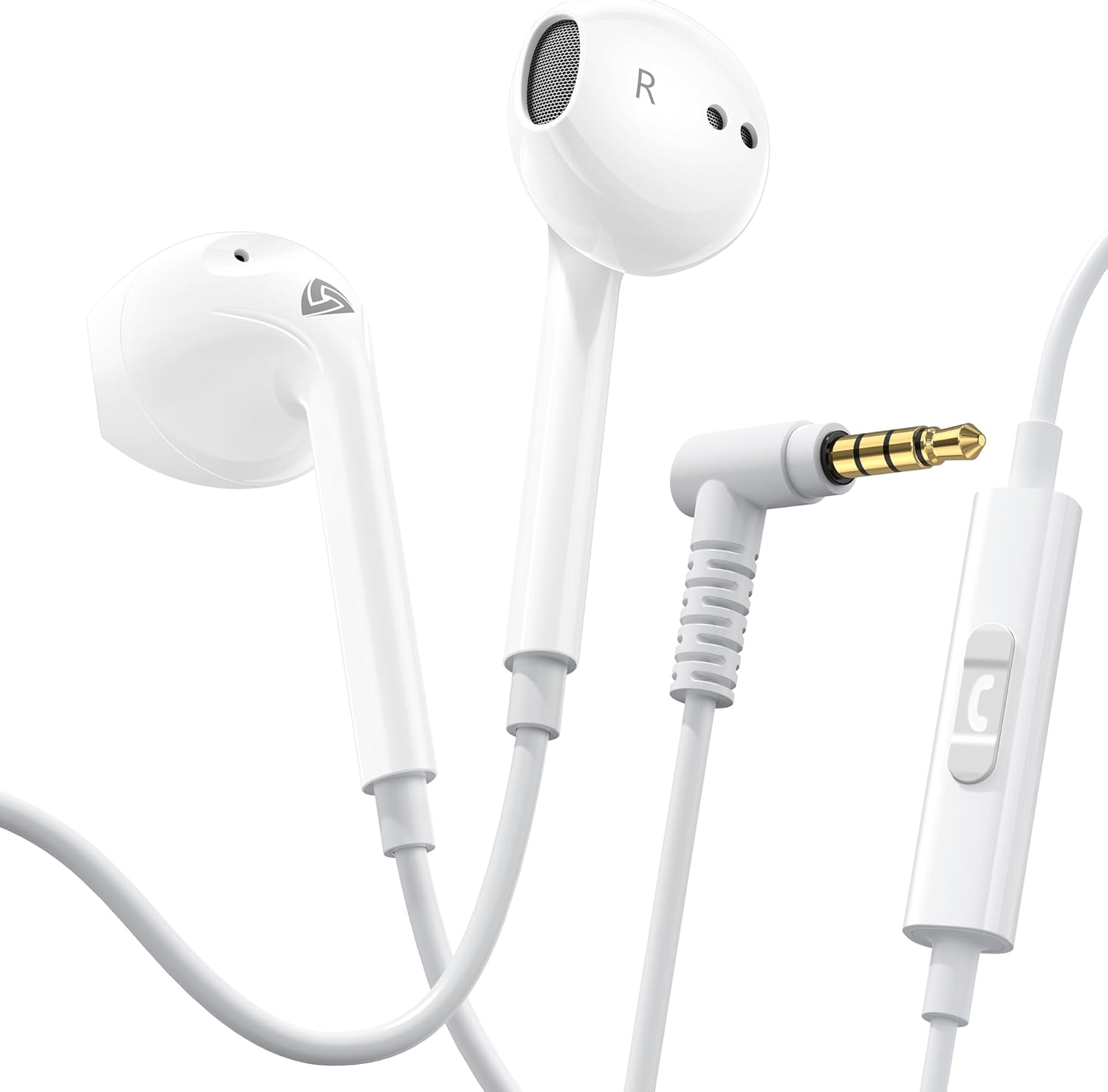
The wired pick: LUDOS Zenith Wired Earbuds in-Ear Headphones, 5 Year Warranty, Earphones with Microphone, Corded for 3.5mm Jack Ear Buds for iPhone, Samsung, Computer, Laptop, Kids, School Students, Women, Small Ear
 Visit on Amazon →
This is the pair to buy when you want a wire, a jack, and nothing to charge. The listing leads with a five year warranty, which is unusual in a tier where most pairs are treated as disposable, and it carries an inline microphone, so calls work fine on a laptop or on any phone that still has the port. The fit is aimed at smaller ears, and that is the detail I care about most, because a cheap pair that hurts is a cheap pair you stop using.
What you give up is everything wireless buys. There is no noise cancelling, the cable will catch on things, and if your phone has no 3.5mm port you are back to an adapter, which is the exact failure point that pushed me off wired in the first place. Budget for replacing that adapter once a year and the math still works.
Flaws but not dealbreakers: You are tethered to the device, which is annoying on a walk and fine at a desk. The cord is the weak point on any wired pair, so treat the plug gently and coil it loosely.
Anyone doing laptop and desktop work, students, parents buying for kids, or anyone who wants a pair that works when everything else in the house is dead should start here. It is also the pair I would keep as a backup no matter which wireless buds you own.
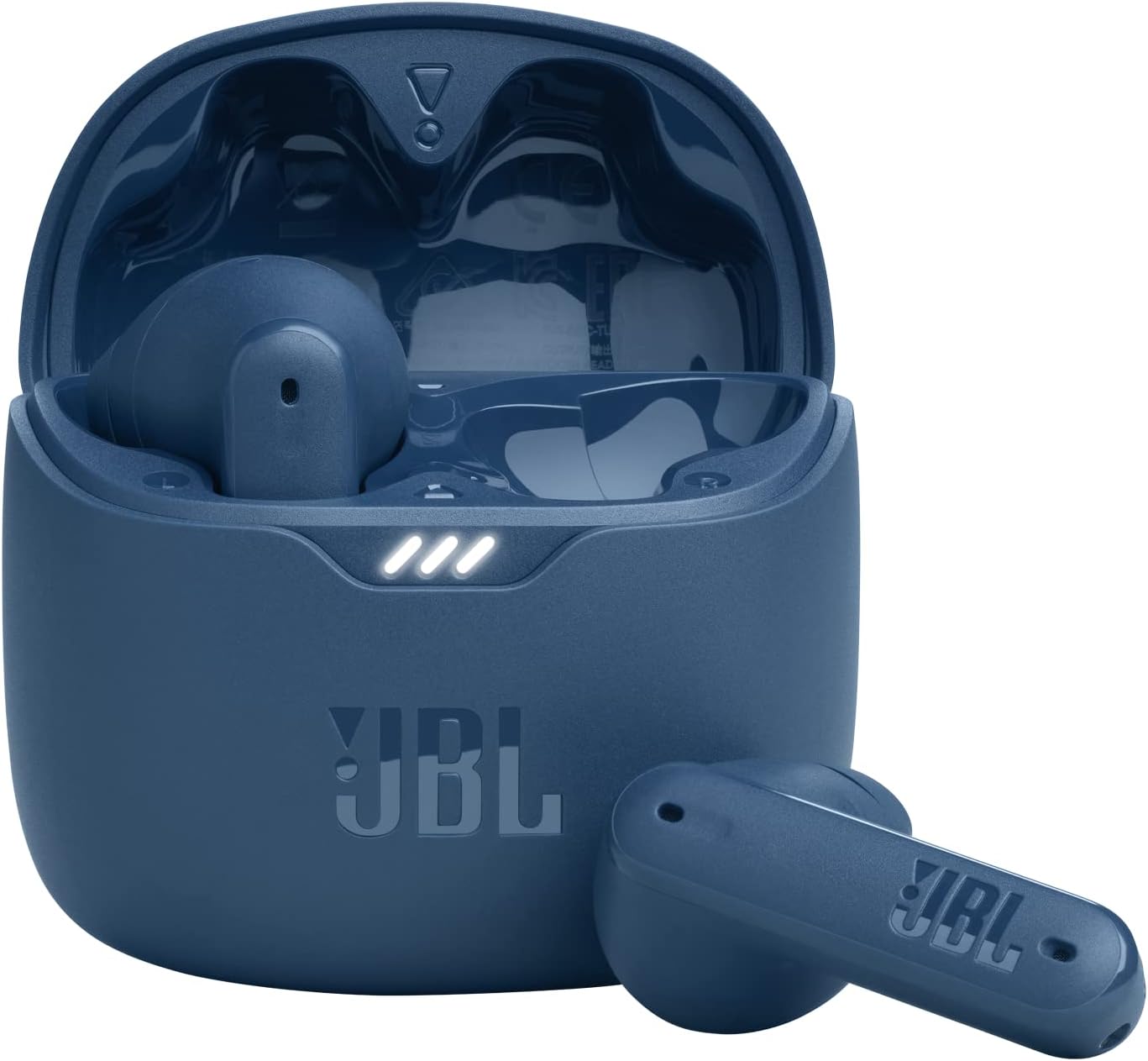
The wireless pick: JBL Tune Flex - True Wireless Noise Cancelling Earbuds (Blue), Small
 Visit on Amazon →
This is the pair to buy when the cable has to go. The listing calls them noise cancelling, and that is the one feature a wired pair in this tier simply cannot give you, which matters if your daily listening happens on a bus, a plane, or in an open office. They are true wireless, so each bud should work on its own, and the small sizing is a real point in their favor if your canals are narrow like mine.
The two checks that decide whether you keep them are the same two I run on every wireless pair. First, battery drain at your normal volume across a full week, not the box number. Second, whether each bud pairs and plays solo, which you test by leaving the right one in the case and running the left one alone. Do both inside the return window and you will know more than any review could tell you.
What you give up is the thing that makes wired simple. There is a battery that ages, a case that has to be charged, and two small objects that can be lost in a parking lot. The case recharges the buds. It does not extend playtime into another dimension, no matter how the marketing copy is worded.
Flaws but not dealbreakers: Any wireless pair depends on a battery you cannot replace, so plan on a few years rather than a decade. If you want the longest possible life, the wired pick above is the safer buy.
Anyone whose phone dropped the jack, anyone commuting, and anyone who needs the noise cancelling more than they need the certainty of a cable should look here first.
The five-question test, in order
Answer these before you open a shopping tab, and you will not need to read a dozen contradicting reviews afterward.
Step one: count your jacks. Go through the devices you actually listen on. If your laptop still has a 3.5mm port and your phone does not, you may genuinely want both pairs eventually, and that is not indecision, it is just the state of things.
Step two: name what you need noise cancelling for. Be specific. A bus every morning, a shared office, a lawn mower, a flight once a year. If the honest answer is nothing, wired is cheaper, simpler, and one less thing to charge. If the answer is a daily commute, go wireless with noise cancelling and do not apologize for it.
Step three: check battery life at your volume. Ignore the headline number on the listing and verify it in your first week of normal use. Return the pair if it does not hold up. This is the single most common reason a cheap wireless pair gets abandoned.
Step four: confirm each bud works alone. Pair the left bud by itself with the right one in the case. If it refuses, you will discover the problem the day one bud dies or gets lost, which is the worst possible time to find out.
Step five: test the volume floor on a quiet night. Turn the volume all the way down and listen. If the quietest setting is still loud enough to blast your eardrums, return them. You will not get used to it, you will just stop using them after dark.
And the advice I never walk back: buy the cheap wired pair as a backup regardless of what else you own. It costs less than most of what is in your bag, it never needs a charge, and it is the pair that saves you the day your wireless buds are sitting dead in a case.
Where people get this wrong
The magic case language is the first trap. A charging case recharges your buds. That is all it does, and any listing that implies otherwise is selling you a feeling.
The second trap is the review rabbit hole. Every review contradicts the last one, and you end up more confused than when you started, having spent four hours to make a thirty dollar decision. Read two reviews, then stop, and let the return window be your real test.
The third trap is fit. Fit beats frequency response. If a pair hurts your ear canals or falls out mid-walk, nothing else about it matters, and no amount of praise from someone with different ears will change that.
The fourth trap is buying a premium wired pair to make a point, then running it through a cheap adapter on a phone with no jack. The adapter is now the weakest link in the chain, and it will fail before the earbuds do.
The fifth trap is the power-on announcement. If a pair greets you like an overenthusiastic receptionist every time you take it out of the case, you will resent it daily. Soft chimes or nothing.
What this all costs
The wired pick is the lowest cost way into decent sound in this tier, and the wireless pick sits in the middle. Both prices move around, so check current Amazon price on each before you buy rather than trusting a number from a blog post, including this one.
The cost-per-day math is not really the interesting part. A pair that lasts two years is a few cents a day either way. The real cost is the pair you replace because it hurt your ears, or because the battery quit at the wrong moment, or because you lost it and had to start the search over. That is the money this article is trying to save you.
Do the five questions once, buy the pair that answers them, keep the cheap wired set as the backup, and stop reading reviews. That is the whole job.