Most budget wireless earbuds are not bad. They are badly chosen. The box promises 50 hours of playback and noise canceling, and what shows up is a pair that dies on the walk home, shouts POWER ON at you like an overenthusiastic receptionist, and bottoms out at a volume that rattles your fillings.
I have bought the same cheap pair three times because I lost it twice, which tells you two things: I am careless, and I know exactly what "good enough" sounds like in this tier. Budget wireless earbuds are cheap enough that the spec sheet barely matters. What matters is whether the pair survives your ears, your commute, and your volume floor during the two weeks after it arrives.
So this is not a spec-sheet argument. It is a test plan. Two weeks, no meters, no rabbit hole. You run the pair through the same gauntlet I run every budget set through, and you decide before the return window shuts.
Why you should trust me
I do live sound and recording-editing work around Nashville, which means my day job is monitor mixes and cleaning up podcast audio. At the desk I use a serious pair of Sony over-ears, the ones that stay home and cost real money. Everything else in my life runs on budget earbuds: walks, chores, the gym, the commute.
I have also got small, easily sore ear canals. Every pair hurts until proven otherwise, no matter the tip size or material, so when I call a pair comfortable I mean it survived my ears, not just a reviewer's. I have been down the review rabbit hole and come out the other side with nothing but contradictory tabs, and I have paid for every pair I have ever written about. I am a repeat buyer in the budget tier, not a sponsored reviewer.
Two more things shape how I judge this stuff. Battery life is the first spec I check, because a pair that dies after two hours is useless no matter how good it sounds. And "fine" is the highest praise I give. Gear that just works beats gear that impresses on paper and annoys you daily.
How I picked and how I tested
The two pairs below are the ones I would hand a friend in this price band, and the checklist that decides it is short. How long does the battery actually last at normal listening volume? Does each earbud work independently? How quiet is the minimum volume setting? Do they stay in through a walk or a workout without hurting my ear canals? Is there an obnoxious power-on announcement or magic-case marketing?
That is the whole test, and the spec sheet never answers it. So here is my honest framing: the numbers printed on these boxes are promises, not results. The feature lists below tell you what each pair is built to do. The gauntlet further down tells you how to find out whether it does it, in your ears, on your phone, inside the return window. Nothing I write here replaces that, and any review that pretends otherwise is selling you something.
Two pairs worth running through the test
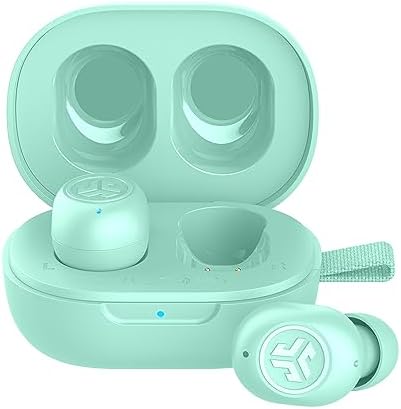
Our pick: JLab JBuds Mini, True Wireless Earbuds, Bluetooth Multipoint, IP55 Sweat Resistant, Be Aware Audio, Teal
 Visit on Amazon →
This is the pair I point people to first, and the reason is multipoint. Multipoint means the buds hold a connection to two devices at once, so you can be listening to a podcast on your laptop and still take a call that lands on your phone without repairing anything. Once you have used it, going back to single-device pairing feels like standing up to change the channel. It is the feature that turns a cheap pair into the pair you actually keep in your pocket.
IP55 is the other half of the pitch. That covers sweat and rain splash, which is exactly what a gym session or a drizzly walk throws at a pair, and it does not cover swimming or a soak in the laundry. Be Aware Audio is the passthrough mode: it pipes the outside world into your ears so you can hear traffic, a bike bell, or someone saying your name. I use passthrough on streets and turn it off indoors, because any passthrough adds a little hiss and thins out the low end while it is on.
The Mini name is not marketing filler. Small buds sit shallower in the ear, which is genuinely good news if your canals are small and sore like mine. The trade is that small housings rarely deliver the low end of a full-size pair, so if you want chest-thump bass, this is not that. Teal is the color, and yes, it matters, because a pair you like looking at is a pair you do not lose in a bag.
Flaws but not dealbreakers: Multipoint is wonderful when two devices behave and maddening when a laptop and a phone fight over the connection. Expect to learn which device wins. Also, passthrough modes are a compromise by nature. You are trading sound quality for awareness, and I would rather you know that going in than be surprised by it.
Anyone who bounces between a phone and a computer all day, sweats in their earbuds, and has small ear canals should start here.
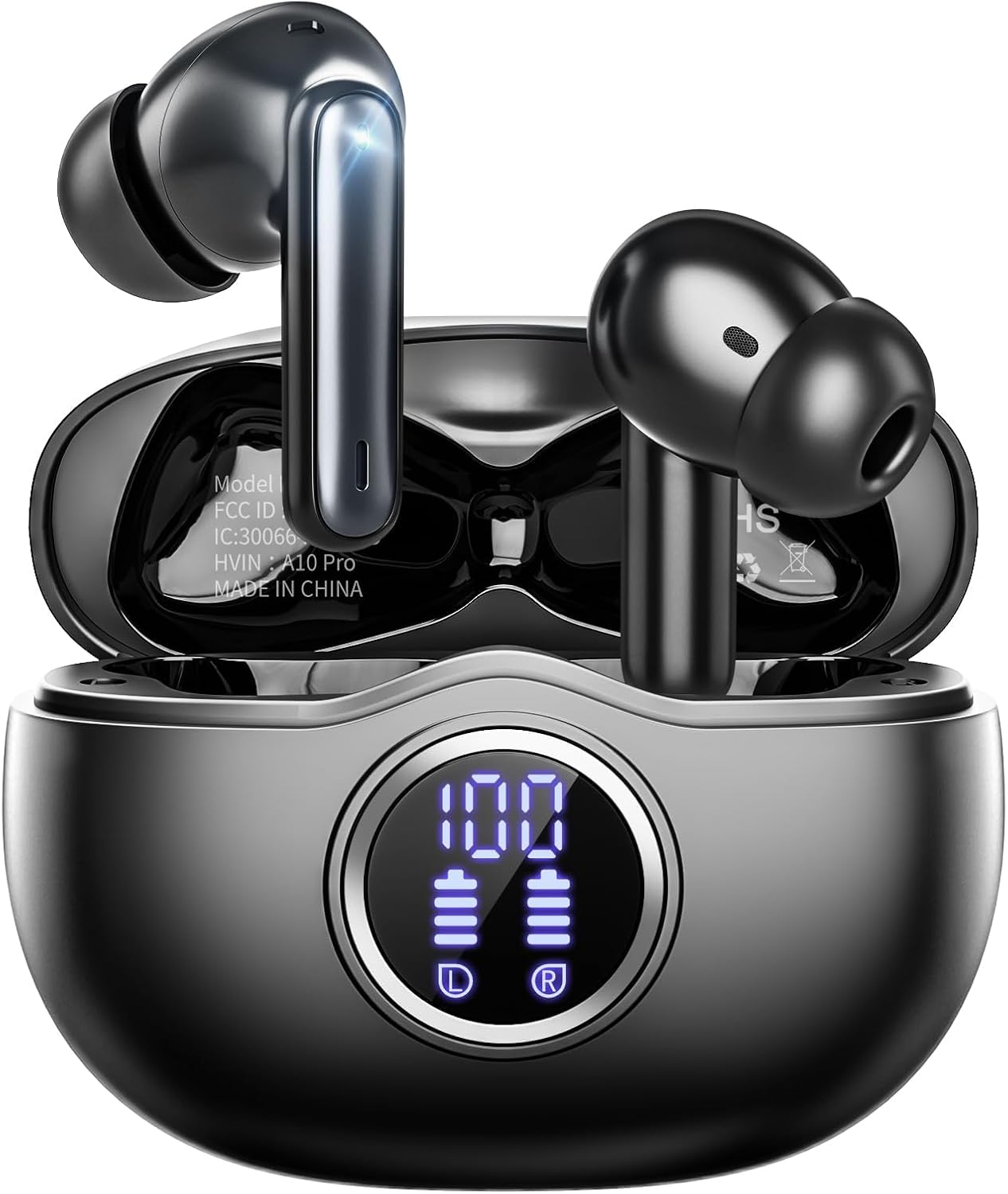
Budget pick: Wireless Earbuds, Bluetooth 5.3 Headphones HiFi Stereo 50H Playback LED Digital Display Ear Buds with ENC Noise Canceling Headset, IPX7 Waterproof Earphones for Gym/Running/Work(Black)
 Visit on Amazon →
This is the cheapest way into features that used to cost real money, and the list reads like a checklist of things I actually care about. Bluetooth 5.3 is the current mainstream version, which mostly means more stable connections and lower latency than the older versions, and lower latency is what keeps audio and video in sync when you are watching something on a phone. ENC is the call feature: the mic array works to subtract background noise from your voice, so the person on the other end hears less street and more you. It does not cancel noise for you. Nothing at this price does, whatever the box says.
IPX7 is the rating I want on a gym pair. It means the buds can take a splash and a sweaty session, and in water resistance terms it sits above the IP55 on the JLab above. What it does not mean is swimming. Do not swim in IPX7 earbuds.
The LED display on the case is a small thing that earns its place. Instead of guessing whether the case has charge left, you look at it. And the 50-hour playback number deserves a straight answer: at this price, that figure is almost always the buds plus the recharges stored in the case, not one charge. A bud that runs a handful of hours at normal volume and then refills from the case is normal. I call the other reading magic-case math, and it is the most common lie in this category.
Flaws but not dealbreakers: This pair does not list multipoint, so plan on pairing it to one device at a time, which is fine if you mostly listen from a phone. Generic pairs also live and die on touch controls, and unresponsive touch controls are the reason I end up grabbing my phone anyway, so test them hard in the first week. The LED display also means a case with a panel on it, and that tends to be bulkier in a pocket than a plain case.
Anyone who wants the lowest entry price, works out in their earbuds, takes calls from the street, and does not need two devices connected at once should look here.
The two-week gauntlet
Now the part that actually decides whether you keep them. Run this in order and you will know by day ten.
Step one: Charge everything and log a baseline. Buds and case, full. Note the time. This is the only number that matters later, because everything you learn after this is a comparison against it.
Step two: Drain at your normal volume, not maximum. This is the test almost nobody runs. Put the pair on at the volume you actually listen at, play something for an hour, and see how much charge is gone. If a bud loses a quarter of its charge in an hour at a comfortable volume, the box number is fiction. If it loses a tenth, you are in good shape. Loud music burns battery faster, which is why a max-volume test tells you nothing about your own week.
Step three: Run each bud solo. Take the right bud out of the case, leave the left one in, and listen. Then swap. Independent use is the feature I did not know I needed until I had it, and it is the difference between one earbud on a call and a dead pair in your pocket. Some pairs only work with the primary bud out. Find out on day one, not on a walk.
Step four: Find the volume floor at night. Lie in a quiet room and turn the volume all the way down. Can you hear it? Is it quiet enough to fall asleep to, or does the lowest setting still blast your eardrums? A pair with a volume floor that starts too loud is unusable for night listening, and no spec sheet mentions it.
Step five: Walk, then work out. Wear them on a normal walk, then on your hardest sweat session. Check the IP rating against your life: IP55 handles sweat and splash, IPX7 handles sweat, rain, and a brief dunk. Neither one swims. If they shift or need pushing back in every block, they fail, no matter how good they sound standing still.
Step six: Do the two-week fit test on your own ear canals. Start with the tips in the box, then try every size. If your canals are small and sore like mine, this is the step that decides everything, because fit beats frequency response. A pair that hurts is a pair you will not wear, and a pair you do not wear is money in a drawer. Give it a full two weeks, because soreness sometimes shows up on day eight, not day one.
Step seven: Pair them with everything. Phone, laptop, tablet, whatever you own. If the pair advertises multipoint, connect two devices at once and switch between them mid-song. If it does not, decide honestly whether one device at a time is enough for your week.
Step eight: Make a real call from a noisy place. Stand on a street or in a busy store and call someone who will tell you the truth. ENC is about how you sound to them, not how they sound to you, so ask. This is also where you learn whether the power-on announcement is a soft chime or a shouted greeting.
Step nine: Do the case math. Count the recharges you actually got. The case is a battery you carry, not a magic extension of playtime, and once you know your real number you can stop believing the box.
Step ten: Decide inside the return window. Put the deadline in your calendar on day one. If the pair failed the fit test or the volume floor, send it back while you still can. That is not being fussy. That is the entire reason budget earbuds are a safe purchase.
The competition and why it lost
My baseline in this tier is still the Soundcore P20i, the pair I have bought three times. Decent bass, each bud works alone, soft power-on sounds, a volume floor that actually gets quiet, and a case that holds a charge forever. It is not in this guide because it is a different article, but it is the standard everything else gets measured against in my head.
The Fhumsh A10 Pro exceeded my expectations for the money, stable Bluetooth with no dropouts and call clarity that held up, and it lives in the same conversation. Open-ear buds, the ones that sit outside the canal, were my compromise for years when my ears hurt too much for anything else. They stop the pain and they cost you sound quality, and I got tired of pretending otherwise.
Wired headphones still sound better than wireless. I will say that until I am hoarse. But the jack is gone, the adapters die on you, and wireless is the practical reality now, so the useful question is not wired versus wireless. It is which wireless pair survives your ears and your week.
What this all costs
Both pairs here sit in the budget tier, so check the current Amazon price at the links above rather than trusting a number I wrote down months ago, because these prices move. The purchase price is not the number that matters anyway. The number that matters is how many times you pay it.
Buy a pair, skip the gauntlet, keep it because returning things is annoying, and you will buy again in four months. Run the ten steps, keep the pair that survives, and you buy once and keep it until you lose it in a parking lot. That is the whole math. The test is free, it takes two weeks, and it is the difference between a drawer full of almost-right earbuds and one pair you reach for without thinking.
That is the job. Do the two weeks. Your ears will tell you the truth faster than any review.